
English 

Views: 0 Author: Site Editor Publish Time: 2026-07-30 Origin: Site


Picture cruising down the interstate at 65 miles per hour. Suddenly, a massive jolt aggressively rocks your truck frame. You immediately glance in the rearview mirror and make a terrifying discovery. Your heavily loaded trailer has completely detached from the primary hitch. In these critical seconds, a strong safety chain acts as the absolute final failsafe. It stands alone between your towed asset and a disastrous highway collision.
Proper secondary securement fundamentally dictates your level of risk. It separates catastrophic legal liability from a highly manageable roadside inconvenience. This article breaks down exactly how you should evaluate compliance, material strength, and implementation methods. We will guide you through selecting the correct securement needed for your specific towing capacity. You will learn how to accurately verify hardware integrity and avoid common rigging mistakes before your next trip.
Legal Compliance: Operating without a rated safety chain violates Department of Transportation (DOT) and state laws, carrying significant liability.
Capacity Matching: Chain strength must strictly align with or exceed the trailer’s Gross Vehicle Weight Rating (GVWR), not its empty weight.
Rigging Geometry: Chains must be crisscrossed beneath the coupler to form a safety cradle, preventing the trailer tongue from striking the pavement during a disconnect.
Hardware Integrity: The hooks and attachment points are just as critical as the chain links; open S-hooks present severe bounce-out risks compared to latching clevis hooks.
A catastrophic failure scenario rarely happens slowly. Mechanical failures strike in fractions of a second at highway speeds. A ball mount can shear under extreme dynamic stress. An unseated coupler can violently bounce off the hitch over a severe pothole. When this primary connection fails, massive kinetic energy instantly transfers to your secondary securement system.
Without proper secondary attachment, the tongue dives directly toward the pavement. If the metal tongue strikes the asphalt while moving forward, it digs into the road surface. We call this the pole-vault effect. The aggressive forward momentum physically launches the trailer into the air. It flips the cargo and usually destroys the tow vehicle alongside it.
Department of Transportation (DOT) regulations mandate secondary securement systems for all towed vehicles on public roadways. Federal and state laws strictly require these links to prevent complete separation during transit. You violate the law the moment you tow without them.
You must consider the difference between basic asset protection and massive legal liability. An adequate securement system protects your cargo from destruction. More importantly, it insulates you as the driver from severe negligence claims following an accident. If your poorly secured trailer disconnects and strikes another motorist, courts will closely examine your rigging methods.
Many drivers mistakenly rely on Original Equipment Manufacturer (OEM) defaults. Relying on degraded, undersized factory links presents a massive false economy. Factory-installed hardware often degrades over time through rust and ground dragging. Furthermore, original hardware rarely accounts for aftermarket trailer upgrades or fully maxed-out payloads. You must independently verify your setup handles your actual road weight.
You must firmly grasp the difference between payload and Gross Vehicle Weight Rating (GVWR). Many operators incorrectly calculate their requirements based solely on the empty weight of the trailer. Your system ratings must account for the absolute maximum total weight. GVWR represents the empty trailer plus the maximum allowable cargo.
The DOT established strict classifications for trailers. You must match your minimum breaking strength to these specific classes. We outlined the mandatory breaking strength requirements in the table below.
Trailer Class | GVWR Weight Range | Minimum Required Breaking Strength |
|---|---|---|
Class 1 | Up to 2,000 lbs | 2,000 lbs |
Class 2 | 2,001 to 3,500 lbs | 3,500 lbs |
Class 3 | 3,501 to 5,000 lbs | 5,000 lbs |
Class 4 | 5,001 to 10,000 lbs | 10,000 lbs |
Material composition dictates performance under heavy stress. Manufacturers use different steel grades to categorize tensile strength and shock absorption. You must select the appropriate grade for your specific hauling demands. The comparison chart below details the most common grades.
Chain Grade | Material Composition | Primary Use Case | Performance Characteristic |
|---|---|---|---|
Grade 30 (Proof Coil) | Low Carbon Steel | Light utility, small boats | High stretch before breaking |
Grade 43 (High Test) | Medium Carbon Steel | Standard enclosed, mid-size RVs | Moderate stretch, higher load limit |
Grade 70 (Transport) | Heat-Treated Alloy | Heavy machinery, skid steers | Low stretch, extreme tensile strength |
You should always verify these ratings physically. Look for stamped load limits directly on the individual links. Quality manufacturers emboss markings like "G43" or "G70" every few links. You must also check the hooks and attachment hardware. The entire system is only as strong as its weakest individual component.
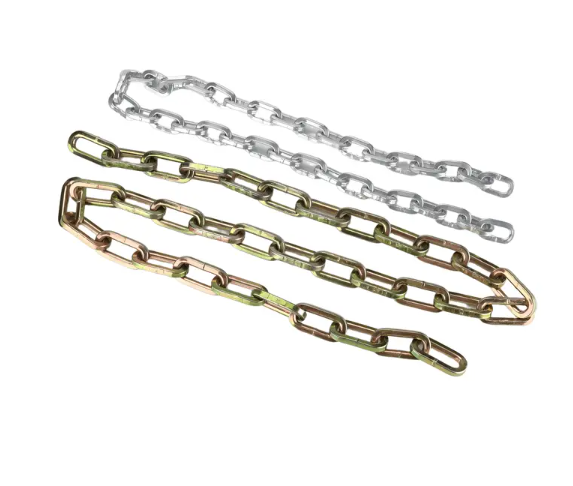
Even the strongest materials fail if you rig them incorrectly. The "crisscross" methodology serves as the universal standard for proper attachment. You must cross the lines directly under the trailer tongue. This specific geometry creates a drop-catch cradle. If the primary hitch fails, the crossed cradle catches the falling tongue. It stops the metal from hitting the pavement and sparking a catastrophic accident.
Follow these specific steps to execute the crisscross method correctly:
Attach the left connection beneath the tongue and route it to the right receiver loop on the tow vehicle.
Attach the right connection beneath the tongue and route it to the left receiver loop on the tow vehicle.
Inspect the resulting "X" pattern to ensure it sits directly underneath the coupler.
Test the turning radius in both directions to confirm you have adequate maneuvering slack.
Verify ground clearance visually to guarantee no links drag against the pavement.
Slack management requires precise mathematical balance. You must establish optimal length before driving. You need enough slack to permit your maximum turning radius. Too much tension binds the connection and limits maneuverability. However, the lines must remain short enough to prevent dragging. They must also remain tight enough to suspend the tongue above the ground during a disconnect.
Attachment points require critical attention. You should utilize frame-welded loops or heavy-duty bolt-on D-rings mounted directly to the tow vehicle receiver. Never attach your secondary securement to the bumper. You must also avoid looping them over the hitch ball itself. The ball can snap off, taking your secondary securement with it.
Hardware selection makes a massive difference in real-world scenarios. We strongly advise against using open S-hooks. They present a high risk of detaching over bumps. A severe pothole can easily bounce an open S-hook right out of the receiver loop. Latching clevis hooks and slip hooks feature spring-loaded gates. They represent the industry standard for reliable transit securement. They lock closed and physically cannot bounce out.
Many owners fundamentally misunderstand the functionality gap between transit gear and anti-theft gear. Dynamic towing requires very specific metallurgical properties. When a heavy load disconnects, it generates a massive shock load. Towing links must stretch slightly to absorb this kinetic energy without snapping.
Conversely, protecting a parked asset requires surface hardness. You need a hardened security chain to effectively prevent trailer theft. Anti-theft equipment uses case-hardened steel. This specific manufacturing process makes the outer layer incredibly resistant to bolt cutters and angle grinders. Thieves easily slice through standard low-carbon towing links.
These material differences mean you cannot safely use one product for both applications. Towing gear stretches to absorb impact but cuts easily. Anti-theft gear resists cutting tools but shatters like glass under sudden towing impacts. The hardened surface makes the steel brittle under dynamic stress.
We recommend acknowledging these limitations clearly. Never use your towing component as a primary theft deterrent overnight. Thieves recognize Grade 30 and Grade 43 links instantly. They bring the right hand tools to defeat them in seconds. You should invest in specialized hitch locks for the coupler. Combine those locks with dedicated hardened steel options for stationary storage. Keep your dynamic gear exclusively for highway transit.
You should routinely audit your current setup before hauling heavy equipment. Proactive inspection prevents catastrophic failure. We recommend looking closely for any signs of mechanical fatigue. Check for link stretching, which indicates the metal previously exceeded its yield strength. Look for severe rust that eats away the structural integrity.
Ground-wear flattening represents a major red flag. When links drag on the highway, friction shaves off the steel. A flattened link loses significant breaking strength. You must also inspect your hooks for spring fatigue. If the safety latch fails to close tightly, you need immediate replacement.
Measuring for a replacement requires attention to routing. You cannot simply measure a straight line. You must measure the required length from the tongue attachment point to the tow vehicle's receiver loops while accounting for the crossover under the tongue. Always measure with the tow vehicle and trailer parked perfectly straight.
Watch out for severe red flags when purchasing new equipment. Avoid any products featuring welded repair links. These aftermarket welds destroy the original heat treatment and introduce weak points. Never buy setups featuring untethered or open hooks. Reject any product lacking clear manufacturer weight rating stamps. Unbranded hardware imports often fail under real-world loads.
Take clear next-step actions based on your specific use cases:
Lightweight utility: Consider heavy-duty coiled cables. They prevent ground dragging while offering adequate strength for Class 1 loads.
Standard cargo: Upgrade to latching clevis hooks on Grade 43 steel. They provide excellent peace of mind for mid-weight hauling.
Heavy equipment: Demand Grade 70 transport steel for skid steers or large marine transport. Ensure every component matches the Class 4 rating.
Treating your secondary securement strictly as a non-negotiable safety system saves lives. It is never an optional accessory or an afterthought. The physics of highway travel dictate that primary hitch failures happen fast and violently. When they do, only your backup system prevents complete disaster.
Always verify capacity by matching hardware strength to your total GVWR. Empty trailer weights lead to dangerous miscalculations. Implement proper rigging geometry every single time you hitch up. The crisscross cradle method remains the only proven way to catch a falling tongue and prevent the deadly pole-vault effect.
Take action before your next haul. Inspect your current hardware thoroughly for rust, stretched links, or ground-wear flattening. Replace any compromised components immediately. Upgrade your open S-hooks to latching clevis hooks to ensure your connection survives rough roads.
A: Yes. All 50 states enforce DOT regulations requiring secondary securement systems for towed vehicles. While specific enforcement penalties vary by jurisdiction, operating without them violates federal transportation standards and state traffic laws universally.
A: You can use rated safety cables for lighter loads. Coiled cables work exceptionally well for Class 1 and Class 2 utility applications because they resist dragging. However, heavy machinery and Class 4 trailers strictly require heavy-duty steel links to handle massive dynamic stress.
A: You can safely shorten them by twisting the links before attaching the hooks to the receiver. You can also utilize heavy-duty rubber tensioners to pull the slack upward. If they still drag, you must replace them with properly measured lengths.
A: Many states now prohibit open S-hooks due to severe bounce-out risks. The DOT and the towing industry strongly recommend shifting to latching clevis or slip hooks. Spring-loaded gates guarantee the hook remains firmly attached to the receiver loop over rough terrain.


