
English 

Views: 0 Author: Site Editor Publish Time: 2026-07-27 Origin: Site


Improper trailer chain attachment represents a massive liability risk on the road today. A single bump can cause a catastrophic disconnect, leading to severe accidents and immediate compliance violations. Relying on guesswork puts lives, cargo, and your legal standing in jeopardy. Most basic guides treat towing like a simple weekend chore. We need to shift focus toward a rigorous technical evaluation of hardware limits, proper crossing techniques, and exact component selection. You cannot afford to ignore the mechanical realities of load distribution. Securing a trailer demands matching your Gross Trailer Weight (GTW) to the correct grade of hardware. Only precise, fail-safe installation protocols guarantee genuine peace of mind. By treating your safety connection as a true system, you ensure total road readiness before every trip.
Safety chains must be crossed under the hitch to create a "cradle" that catches the trailer tongue in the event of a disconnect.
The total Working Load Limit (WLL) of your security chain setup must meet or exceed the Gross Trailer Weight (GTW).
Twisting chains to shorten them reduces their tensile strength and should be avoided; permanent resizing is the compliant standard.
Attachment hooks must feature latches (clevis or slip hooks) rather than open S-hooks for maximum liability protection.
Trailer towing demands strict adherence to physical laws and established engineering standards. When a coupler detaches at highway speeds, you rely entirely on your emergency connections. Proper attachment methods dictate whether you maintain control or experience a catastrophic wreck.
You must cross your chains directly beneath the trailer coupler. You run the left trailer chain to the right vehicle receiver loop. Then, you run the right trailer chain to the left vehicle loop. This specific crossing geometry serves a critical physical purpose. It builds a supportive basket or "cradle" under the tongue.
If the trailer decouples, the tongue drops directly into this cradle. It never strikes the pavement. If a heavy tongue hits the road at sixty miles per hour, it acts like a pole vault. It can flip the trailer instantly. The crossing method prevents this violent reaction. It keeps the trailer tethered close to the vehicle. You retain steering capabilities and can bring the rig to a safe, controlled stop.
The Department of Transportation (DOT) strictly regulates towing connections across most jurisdictions. While specific state laws vary slightly, baseline federal standards demand continuous, secure connections. DOT officers routinely inspect commercial and heavy recreational setups. They look for appropriate chain thickness and correct crossing geometry.
Failure to cross chains often results in immediate citations. More importantly, non-compliance exposes you to severe legal liability. If an accident occurs due to improper attachment, insurance companies will investigate the hardware setup. Using unrated components or skipping the crossing protocol often nullifies coverage.
Many operators fundamentally misunderstand load ratings. You must differentiate between Breaking Strength and Working Load Limit (WLL). Breaking Strength defines the exact point of catastrophic physical destruction. It represents the maximum force a component survives before snapping. WLL represents the maximum safe operating load for continuous use.
You should only use WLL metrics when sizing your towing hardware. Rigging standards typically calculate WLL as one-third or one-fourth of the breaking strength. Furthermore, towing systems follow the weakest link principle. If you pair a heavy-duty chain with a low-grade carabiner, your true WLL drops to the carabiner's rating. You must verify every single component. The chain, the attachment hooks, and the receiver loops must all individually exceed the trailer's Gross Trailer Weight (GTW).
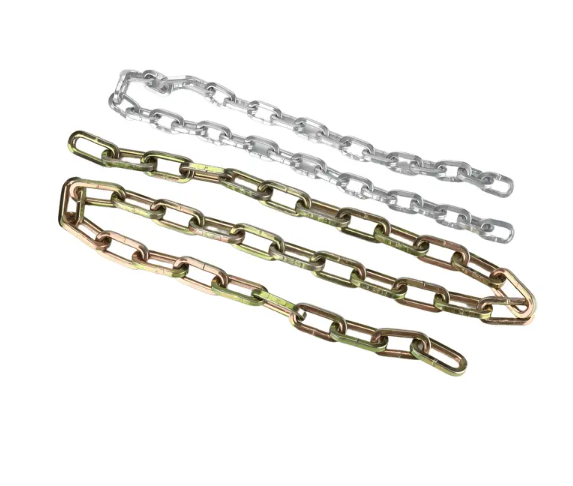
Selecting appropriate hardware dictates the absolute baseline of your towing safety. You cannot upgrade weak metal through careful driving. You must purchase appropriate materials from the start.
Manufacturers grade steel chains based on their tensile strength and carbon content. You must align these grades with your specific towing application.
Grade 30 and 43: These represent standard utility applications. Manufacturers use low-carbon steel for Grade 30 proof coil. They use higher carbon steel for Grade 43 high test. These work well for lightweight landscaping trailers or small boat carriers.
Grade 70 (Transport): This represents the gold standard for most demanding towing. Manufacturers heat-treat this carbon steel for superior strength. DOT mandates Grade 70 for heavy commercial tie-downs and heavy-haul trailers. Properly integrating a high-strength safety chain protects against extreme shock loads.
Grade 80+ (Alloy): Professionals use alloy chains for overhead lifting. They also use them for extreme heavy-duty towing. They offer the highest strength-to-weight ratio available.
Chain Grade | Material Type | Common Application | Relative Strength |
|---|---|---|---|
Grade 30 | Low Carbon Steel | Light Utility Trailers | Base Level |
Grade 43 | Carbon Steel | Medium Enclosed Trailers | Moderate |
Grade 70 | Heat-Treated Carbon | RVs, Commercial Flatbeds | High / DOT Approved |
Grade 80+ | Heat-Treated Alloy | Industrial Heavy Haul | Maximum |
The ends of your chains demand equal scrutiny. An excellent chain fails instantly if a cheap hook bends or bounces off the receiver.
Open S-Hooks: Avoid these for anything beyond a tiny yard cart. They lack closing mechanisms. When you drive over a speed bump, the trailer tongue bounces. This bounce creates slack. S-hooks can jump right out of the receiver loops. They provide inadequate security for heavy loads.
Clevis Hooks with Latches: These represent the modern industry standard. They feature a spring-loaded gate that snaps shut. Once secured, they cannot decouple over rough terrain. They lock the connection physically.
Threaded Quick Links: These hardware pieces feature a threaded barrel closure. You screw them completely shut. They work perfectly for permanently mounting chains to the trailer tongue itself. However, they must be stamped with a WLL equivalent to your chain grade. Unstamped quick links belong in the trash.
Your entire security chain setup requires meticulous execution. You must establish a repeatable routine every time you hitch up. This eliminates dangerous oversights.
Begin with a mandatory visual check. You must look closely at the receiver loops on your tow vehicle. Check the welds for hairline fractures. Rust often hides metal fatigue. Next, inspect the trailer tongue mounting points. Look at the chains themselves. If you spot elongated links, gouges, or severe rust, stop immediately. Stretched links indicate previous shock-loading. They possess compromised structural integrity.
Execute the mandatory cross right beneath the coupler. Take the driver-side trailer chain. Run it to the passenger-side receiver loop on your truck. Take the passenger-side trailer chain. Run it to the driver-side receiver loop. This forms an X directly under the hitch. Ensure the chains do not tangle around each other. They must hang cleanly.
You must attach the hooks facing a specific direction. Always push the hooks through the receiver loops from the bottom up, or face them outward. Never attach a hook facing downward toward the pavement. If a downward-facing hook strikes road debris, the impact forces the latch open. Upward or outward-facing hooks deflect ground strikes safely. This tiny detail saves lives during emergency stops.
Proper slack management requires precision. If chains hang too low, they drag on the asphalt. Pavement acts like a grinding wheel. It rapidly shaves away steel, causing abrasive failure. If chains hang too tight, they bind during turns. This binding can snap the chain or rip the loop off the truck. To validate clearance, connect the trailer and execute a tight 90-degree turn in a parking lot. Get out and look. The outer chain should pull tight without straining. The inner chain should droop without touching the ground.
Even experienced operators fall victim to bad habits. Let us dismantle some dangerous practices that quietly destroy your safety margins.
Drivers frequently twist chains to shorten them. This prevents dragging on the ground. You must never do this. Twisting a chain fundamentally alters its load distribution. Chain links manage stress linearly. When you twist them, they crush against each other under tension. This introduces severe torsional stress. Engineering tests prove that twisting can reduce a chain's tensile strength by over fifty percent. If your chains drag, cut them down permanently. Reattach the hooks using approved clevis pins. Do not rely on twisting.
Some drivers attach hooks to non-structural vehicle components. They hook them to flimsy bumper cutouts or decorative trim. This guarantees failure. In an emergency, the trailer will rip the bumper completely off the truck. You must only attach chains to certified hitch receiver loops. These loops weld directly to the thick steel of the hitch receiver, which bolts into the truck's main frame.
We discussed the weakest link principle earlier. People frequently ignore this during repairs. A driver might break a hook. They visit a hardware store and buy a cheap aluminum carabiner. They attach this carabiner to a heavy Grade 70 chain. This creates a massive hidden danger. The carabiner might have a WLL of just 300 pounds. The chain holds 15,000 pounds. Under stress, the carabiner shatters instantly. Always match the hardware grades perfectly.
As your towing needs evolve, your hardware must keep pace. Factory chains often represent the bare minimum legal requirement. You should proactively seek better solutions.
You should replace your chains when specific trigger scenarios occur. If you upgrade to a Weight Distribution Hitch (WDH), you often need longer chains to clear the new hardware. If you transition to frequent heavy-haul towing, you should discard standard utility chains. Always upgrade to Grade 70 transport chains. Finally, visible degradation mandates replacement. Surface rust is acceptable. Deep pitting is not. Elongated links mean the chain has survived a severe shock load. It will not survive a second one.
You face a choice when buying replacements. Do you buy pre-assembled kits or source cut-to-length chain? Pre-assembled kits offer guaranteed WLL ratings for the entire assembly. The manufacturer tested the chain and the hooks together. This removes guesswork.
However, cut-to-length chain offers precise fitment. If you choose this route, you must buy certified clevis hooks separately. You attach these hooks using heavy steel pins and cotter keys. This requires careful shopping. You must ensure the separate clevis hook rating exceeds the cut chain rating.
Consider this brief checklist for upgrading your system:
Identify your trailer's Gross Trailer Weight (GTW) via the manufacturer sticker.
Procure a rated chain assembly where the WLL significantly exceeds the GTW.
Verify the new assembly includes spring-latched clevis hooks.
Inspect the trailer tongue mounting points. If they look worn or compromised, schedule professional welding services immediately.
Proper trailer securement requires mechanical discipline and exact hardware matching. You cannot compromise on the geometry of your connections. Crossing the chains forms a vital protective cradle that manages kinetic energy during an emergency decouple. Furthermore, you must respect the Working Load Limit (WLL) of every single component. The chain, hooks, and receiver loops must act as a unified, high-strength system. Upgrading to Grade 70 components and utilizing spring-latched clevis hooks drastically reduces your liability on the road. Finally, always perform a visual inspection and a physical tension test before moving the vehicle. Make this simple verification a permanent part of your pre-trip routine.
A: Yes. Crossing the chains forms a supportive physical cradle directly under the hitch. If the coupler detaches, this cradle catches the trailer tongue before it strikes the pavement, helping you maintain steering control and manage turning tension safely.
A: While specific state laws might not explicitly ban twisting, engineering consensus heavily advises against it. Twisting introduces severe torsional stress that crushes the links together, drastically lowering the chain's Working Load Limit. Always shorten chains by permanently removing links instead.
A: You need a chain setup where the combined Working Load Limit (WLL) exceeds 10,000 lbs. A 5/16-inch Grade 70 transport chain typically offers a WLL of about 4,700 lbs per chain. Using two of these provides a comfortable safety margin for a 10,000 lb load.
A: Yes. You can safely use threaded quick links for permanent tongue mounting, provided they are properly stamped. The stamped WLL on the quick link must equal or exceed the required rating of the chain and the overall Gross Trailer Weight.


