
English 

Views: 0 Author: Site Editor Publish Time: 2026-08-02 Origin: Site


Trailer towing demands rigorous risk management every time you hit the road. Catastrophic hitch failure remains a low-probability but incredibly high-severity event. You simply cannot ignore this hazard when hauling heavy loads. Relying solely on your primary hitch connection is both physically insufficient and legally non-compliant across most jurisdictions. A properly rated safety chain acts as your ultimate fail-safe. It keeps your trailer tethered to the tow vehicle during unexpected decoupling scenarios. This guide serves as a complete technical evaluation framework for safeguarding your towing setup. You will learn exactly how to select, rate, and deploy these underway systems for maximum protection. We also detail how to deploy a hardened security chain to defend stationary trailers against modern theft tactics.
Capacity is Non-Negotiable: The minimum breaking strength of each individual safety chain must equal or exceed the Gross Vehicle Weight Rating (GVWR) of the trailer.
The Crossing Rule: Chains must be crossed beneath the coupler to create a supportive "cradle" that prevents the tongue from striking the pavement in a disconnect scenario.
Hardware Matters: The system is only as strong as its weakest link; unrated S-hooks or standard quick links often fail DOT compliance and physical stress tests.
Dual Protection Needs: Underway safety chains prevent road accidents, while a hardened security chain is required to prevent stationary trailer theft.
Trailer detachment poses severe financial and legal risks for any driver. A runaway trailer transforms into an unguided missile on the highway. It can cause catastrophic property damage to other vehicles. It endangers lives and opens you up to massive liability lawsuits. Commercial insurance policies routinely invalidate coverage if investigators discover faulty connections post-accident. You must treat this towing hardware as critical life-saving infrastructure.
State and federal Department of Transportation (DOT) agencies heavily regulate towing operations. They mandate two independent tethers for all non-fifth-wheel towing applications. You face steep fines if highway inspectors catch you violating these essential rules. DOT officers routinely check setups during commercial weigh station stops. They will ground your vehicle if they spot substandard connections.
Many owners assume their factory standard equipment offers total protection out of the box. This assumption often proves dangerous in real-world scenarios. OEM components on budget or used trailers rarely handle maximum payload operations safely. Manufacturers frequently install minimum-spec hardware to reduce initial production costs. They focus on moving units off the lot rather than maximizing safety margins. You should evaluate these standard components immediately after purchasing a new or used trailer. Upgrading to heavier-duty options remains a very cheap insurance policy against catastrophic highway accidents.
Proper weight capacity prevents disastrous mechanical failures during an emergency disconnect. You must match your equipment precisely to the Gross Vehicle Weight Rating (GVWR). Federal regulations require each individual line to independently support the entire loaded trailer weight. If one side fails entirely, the remaining connection must hold the entire dynamic load. Buyers often confuse Working Load Limit (WLL) and Minimum Breaking Force (MBF). WLL indicates safe daily operational loads for lifting applications. MBF represents the absolute failure point under extreme physical stress. Always size your towing equipment based on the MBF exceeding your specific GVWR.
Material grades dictate the overall strength and durability of the metal. Grade 30 and 43 feature high-test carbon steel construction. They work perfectly for light utility trailers and small marine setups. Grade 70 transport models utilize specialized heat-treated boron steel. The heat treatment creates an exceptionally hard, durable exterior surface. Commercial fleets, heavy equipment haulers, and multi-horse trailers absolutely mandate Grade 70 strength. Industry experts warn against buying unlabeled hardware online. Unlabeled products undergo zero physical stress testing. Always verify the manufacturer stamps the grade directly onto the metal links.
Environmental factors also matter greatly when choosing surface finishes. Boat trailers endure constant water immersion and road salt exposure. Galvanized finishes offer superior rust prevention compared to standard zinc plating. Zinc plating looks shiny but flakes off quickly under heavy abrasion.
Common Trailer Chain Grades and Applications
Grade Type | Material Construction | Best Application Scenarios | Relative Strength |
|---|---|---|---|
Grade 30 (Proof Coil) | Low carbon steel | Light landscaping trailers, small boats | Low |
Grade 43 (High Test) | Medium carbon steel | Standard utility, medium marine vessels | Medium |
Grade 70 (Transport) | Heat-treated carbon alloy | Heavy commercial hauling, livestock, RVs | High |
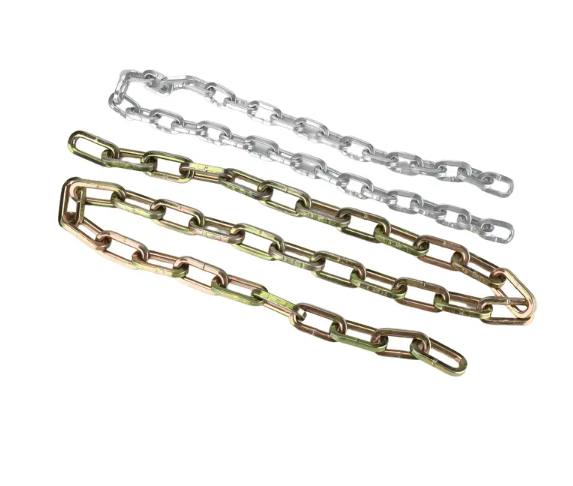
Your hardware system remains only as strong as its absolute weakest link. Towing experts frequently debate the merits of S-hooks versus clevis slip hooks. S-hooks present significant vulnerability when driving on rough or uneven terrain. A harsh pothole bump can easily dislodge an open S-hook from the receiver. We strongly advocate for clevis hooks featuring integrated safety latches or robust wire retainers. These latches physically lock the hook securely onto the truck's receiver loop. They prevent dangerous bounce-outs during bumpy transits.
Mounting points demand equal scrutiny and regular physical inspection. You must attach hooks to dedicated, frame-mounted receiver loops on the tow vehicle. Never hook attachments to a weak sheet-metal bumper. Never wrap them around the hitch ball itself to save time. These improper methods guarantee total failure during an emergency disconnect scenario. A heavy load will rip a thin bumper completely off the truck.
Trailer tongue connections require permanent structural integrity to absorb shock loads. DOT standards recognize both professional welding and heavy-duty bolted connections as safe. Welds must penetrate deeply without compromising the original link temper. Bolted connections must utilize Grade 8 hardware and nylon locking nuts. These premium fasteners resist the constant road vibration naturally generated during transit.
Keep these hardware guidelines in mind:
Replace any hook showing visible bending or stretching immediately.
Ensure latch springs provide strong, snappy resistance when pressed.
Verify frame loops lack deep rust or structural stress cracks.
Avoid basic quick links unless they carry a certified weight stamp.
Proper routing transforms standard metal links into a highly functional safety system. You must employ the crossing rule beneath the trailer coupler. Attach the left trailer line to the right truck receiver loop. Attach the right trailer line to the left truck receiver loop. This simple geometric action creates a supportive physical cradle beneath the tongue. If your hitch fails, the heavy tongue drops directly onto this supportive cradle. It prevents the steel tongue from digging dangerously into the rushing pavement. Pavement strikes often cause trailers to pole-vault and violently flip over.
Optimal length requires careful calibration before you begin driving. Too much slack causes the metal to drag aggressively on the road. Dragging generates sparks and rapidly grinds away the protective link thickness. Safety experts note dragging hardware sparks frequently on asphalt. These sparks easily ignite dry brush along highway shoulders. Forest services often fine drivers heavily for starting roadside fires this way.
Too little slack severely restricts your safe turning radius. A tight line will bind or violently snap during sharp parking maneuvers. You want enough slack to handle maximum turning angles safely. Many drivers twist links to shorten them temporarily before driving. We advise extreme caution regarding this very common practice. Minor twisting remains permissible for quick, temporary length adjustments. However, excessive twisting places immense shear stress on the individual metal loops. It drastically reduces overall tensile strength and invites premature snapping.
Follow these steps to determine optimal slack:
Hook up the trailer on flat, even ground.
Cross the lines and attach them to the truck receivers.
Drive slowly into a maximum turning angle in both directions.
Observe the outer line for binding and the inner line for dragging.
Adjust the mounting point or chain length if necessary.
Underway systems protect you efficiently from severe traffic accidents. However, stationary assets face an entirely different and malicious threat profile. Professional thieves target parked trailers relentlessly in urban and rural areas alike. Standard towing links offer virtually zero resistance to modern theft tools. You need a dedicated security chain to lock up unattended equipment effectively. This specialized hardware actively thwarts heavy bolt cutters and portable angle grinders.
Material hardness dictates actual theft resistance in the real world. Standard carbon steel cuts like warm butter under 36-inch manual bolt cutters. You must invest in through-hardened or specific boron steel alloys. The intense manufacturing process hardens these links to defeat manual cutting jaws entirely. Thieves looking for an easy score will quickly move on to softer targets.
Link shape provides another critical defense layer against common attacks. Square or hexagonal links flatten the exposed cutting surface. Manual cutters cannot grip these flat edges effectively to apply pressure. This smart design forces thieves to use noisy, time-consuming power tools instead. You must pair this hardened metal with proper padlock synergy for total protection. Match your hardened setup with a heavy-duty shrouded shackle padlock. Shrouded locks cleverly hide the vulnerable shackle steel from direct attack. They completely eliminate exposed leverage points for heavy pry bars.
Choosing the right gear immediately streamlines your overall risk management strategy. We recommend categorizing your specific purchases based on exact daily usage scenarios. Light utility owners hauling small boats should focus on Grade 43 options. Pair them with standard retainer hooks for highly reliable daily use. Heavy commercial operators, RV owners, and livestock haulers face much stricter requirements. You must mandate Grade 70 models equipped with heavy-duty clevis slip hooks.
Protecting stationary assets requires a smart dual implementation approach. Pair your standard OEM underway setup with a specialized hardened defense link. Use this heavy-duty combination specifically for unattended long-term storage.
Regular maintenance ensures your equipment provides continuous, reliable protection. Perform a comprehensive visual inspection before every single highway trip. We recommend a strict three-point checklist to catch early warning signs. You can identify potential failures before they compromise your payload.
Pre-Trip Inspection Protocol
Component | Warning Signs | Required Action |
|---|---|---|
Metal Links | Elongation, stretching, deep road gouges | Replace entire unit immediately |
Hardware Hooks | Bent openings, broken safety latches | Swap hooks or install new latches |
Mounting Welds | Hairline cracks, flaking rust at base | Grind and re-weld professionally |
Protecting your valuable equipment requires constant vigilance on the highway and in the driveway. A highly rated safety chain guarantees your rig survives unexpected hitch failures during transit. Meanwhile, heavy-duty stationary locks deter sophisticated thieves looking for quick targets. Upgrade any questionable OEM hardware immediately to meet strict DOT standards. Adopt the crossing method to build a reliable physical cradle under your trailer tongue. Finally, conduct rapid visual inspections before you put your vehicle in gear. This small hardware investment pays massive dividends in long-term risk reduction.
A: Only if the quick link is explicitly stamped with a Working Load Limit (WLL) that exceeds the trailer's Gross Vehicle Weight Rating (GVWR). Standard hardware store links remain entirely unsafe and strictly non-compliant for highway towing.
A: Yes, this practice remains perfectly legal. However, only a certified professional welder should perform this task. They must use proper techniques to ensure the extreme heat does not compromise the protective temper of the individual links.
A: Yes, standard towing links fall easily to basic manual bolt cutters. A hardened security chain utilizes specialized boron steel alloys engineered specifically to resist aggressive cutting attacks when parked.
A: You need just enough slack to allow for the maximum turning angle of the tow vehicle without binding. Keep them short enough to prevent the tongue from striking the ground directly during an unexpected drop.


